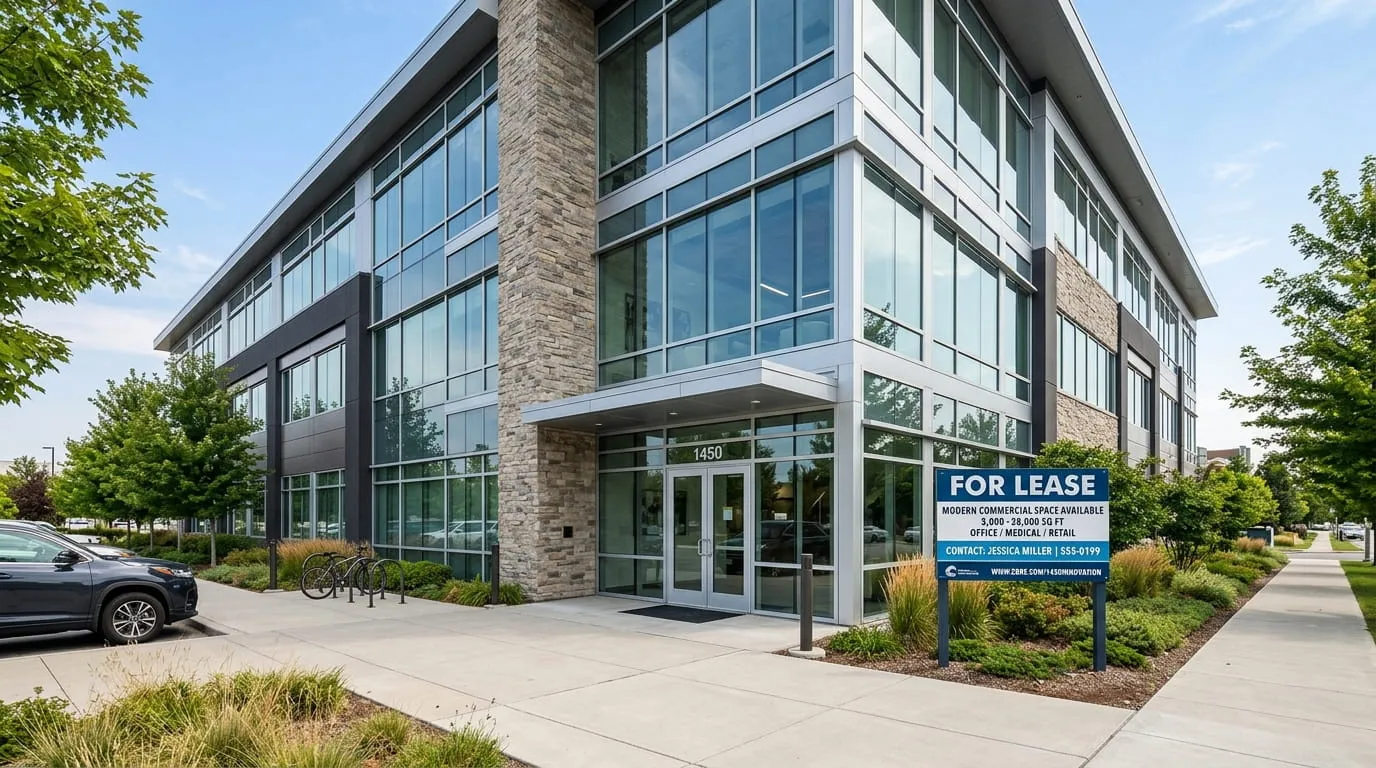


Commercial real estate for lease is business space you rent from a landlord, usually under a multi-year contract that covers base rent plus a share of building costs. In the US, you find it through listing platforms like LoopNet and Crexi, local brokers, and direct landlord contacts. Then you compare offers by total occupancy cost, not the quoted rate alone.
The right space depends on your industry, headcount, customer traffic, and budget. This guide covers property types, lease structures, real costs, search methods, negotiation points, and the mistakes that most often cost tenants money.
What Types of Commercial Space Can You Lease?
Commercial property falls into a few main categories, and each leases differently. Office space ranges from a single suite to full floors in a high-rise. Retail covers storefronts, strip-center units, and pad sites, where visibility and foot traffic drive price.
Industrial space includes warehouses, distribution buildings, and light manufacturing units, priced mostly on clear height, dock doors, and truck access. Flex space blends office and warehouse, which suits showrooms, labs, and small e-commerce operations. Medical and restaurant spaces are specialty categories because they need plumbing, ventilation, or electrical work that a standard shell does not include.
Residential tenants get strong protection from state statutes. Commercial tenants get far less, so the written lease does most of the work, and that is why the terms matter more than most first-time tenants expect.
Lease Types Explained
The lease type decides who pays for taxes, insurance, and upkeep. Two spaces with the same base rent can differ by thousands of dollars a month once those costs are assigned.
1. Full-Service Gross Leases
You pay one rent figure, and the landlord covers taxes, insurance, maintenance, and usually utilities and janitorial. This is common in multi-tenant office buildings. Many landlords set a base year, and you pay your share of any operating expense increase above that year’s level.
2. Modified Gross Leases
This sits between gross and net. Base rent covers some costs, and the tenant pays others, often utilities and in-suite janitorial. Read the exhibit that lists responsibilities line by line, because the split is negotiable.
3. Triple Net (NNN) Leases
Under a triple net lease, the tenant pays base rent plus property taxes, building insurance, and common area maintenance (CAM). NNN is standard for retail centers and industrial buildings. The base rent looks lower, but the add-ons are billed monthly as estimates and reconciled once a year, which can produce a surprise bill.

4. Percentage and Absolute Net Leases
Some retail landlords add percentage rent, meaning you pay a share of gross sales above a set threshold. Absolute net leases push nearly everything, including structural repairs, onto the tenant and appear most often with single-tenant buildings. Have an attorney explain any structural-repair language before you agree.
What Commercial Space Really Costs
Rent is quoted per square foot, but the time period varies. Many office and retail listings quote per square foot per year, while some markets, including much of California, quote per square foot per month. Confirm the unit before comparing listings.
Square footage is the next trap. Rentable square feet include a share of hallways, lobbies, and restrooms, while usable square feet are the space you actually occupy. Office buildings often measure using standards published by BOMA International, so ask which edition the landlord applied.
Then add the costs outside base rent: CAM, tax and insurance pass-throughs, utilities, parking fees, signage, and after-hours HVAC charges. Budget also for the security deposit, build-out costs beyond the tenant improvement allowance, and moving and IT setup.
Here is a simple illustration with hypothetical numbers. A 2,000-square-foot retail unit quoted at $30 per square foot per year on an NNN basis has base rent of $60,000, or $5,000 a month. If NNN charges run $9 per square foot, that adds $18,000 a year, or $1,500 a month.
Your real occupancy cost is $6,500 a month before utilities, 30 percent above the quoted figure. Divide total annual occupancy cost by projected annual revenue to test whether a retail location can work. Acceptable ratios vary by industry, so check benchmarks for your category.
Where to Find Listings and Who Can Help
Start with the large platforms. LoopNet and Crexi both let you filter by property type, size, and city, and CoStar, which owns LoopNet, offers deeper market data through a paid subscription that many brokers use. Landlord websites and “For Lease” signs still surface spaces that never reach a portal, especially in small towns and neighborhood corridors.
A tenant representation broker is worth considering. In most deals, the landlord’s listing agreement pays the commission, so the broker’s help often costs you nothing directly, though you should confirm this in writing. A good tenant rep knows which landlords are flexible, which buildings have hidden problems, and what concessions comparable tenants received.

Visit the target area at different times of day. A strip center that looks busy at noon can be empty at 7 p.m., which matters if your customers arrive after work. Count the vacant units too, since a cluster of them says something about local demand.
Matching the Space to Your Business
1. Zoning and Permitted Use
Before touring, check that local zoning allows your use. A dental office, a bar, and a light-manufacturing shop each face different rules, and a landlord’s assurance is not a legal guarantee. Call the city or county planning department and ask about the certificate of occupancy for your specific use.
2. Access, Parking, and Power
Retail and medical tenants should count parking spaces per thousand square feet. Industrial tenants need clear height, dock-high doors, truck turning room, and enough electrical capacity. Ask for the building’s amperage and phase before assuming heavy equipment will run.
3. Accessibility and Building Condition
Commercial buildings generally must meet Americans with Disabilities Act (ADA) requirements, and leases often assign responsibility for upgrades. Ask who pays if your build-out triggers an alteration. Inspect the roof, HVAC age, and plumbing too, since repairs may fall on you under a net lease.
The Leasing Process From Letter of Intent to Move-In
Most deals follow the same sequence. You tour spaces, narrow to one or two, and submit a letter of intent (LOI) covering rent, term, concessions, and improvement allowances. The LOI is generally non-binding, but it frames the lease, so negotiate here rather than later.
Once the landlord agrees, the landlord’s attorney typically drafts the lease. Expect to provide financial statements, tax returns, or a business plan, since landlords underwrite tenants much like lenders do. New businesses without a track record are often asked for a larger deposit or a personal guaranty.
Have your own commercial real estate attorney review the draft. Landlord-form leases favor the landlord, and many provisions that look standard are negotiable. Allow several weeks from LOI to signed lease, longer if the space needs permits.
After signing, you submit plans, pull permits, and coordinate the build-out. Rent may start on a fixed date whether or not construction is finished, so check whether the lease includes a rent abatement period.
Lease Clauses Worth Negotiating
Term length comes first. Longer terms often earn better concessions, but they lock you in if the business changes. Ask for a renewal option priced by a defined formula, such as a fixed increase or fair market value with a cap, so you do not face an open-ended reset.
Annual escalations should be stated clearly, either as fixed steps or tied to the Consumer Price Index. Compare total rent over the full term, not just year one.
For CAM charges, request a cap on controllable expenses and the right to audit the landlord’s records. Make sure capital expenditures, such as a new roof or parking lot replacement, are excluded from operating costs or at least spread over their useful life.
A personal guaranty puts your own assets behind the lease. Negotiate a dollar cap or a burn-off after a set number of on-time years, or offer a larger security deposit instead.
Assignment and sublease rights let you exit if you sell the business or outgrow the space. Ask that landlord consent not be unreasonably withheld.
Retail tenants should ask for an exclusive use clause, which stops the landlord from leasing nearby space to a direct competitor. Co-tenancy clauses reduce rent if an anchor tenant leaves. Check relocation rights as well, since some landlords reserve the ability to move you to another suite.

Finally, look at holdover rent, which is often set well above your regular rent if you stay past the term. Get the tenant improvement allowance amount, payment timing, and contractor requirements in writing.
Accounting and Tax Points to Raise With Your CPA
Under the FASB standard ASC 842, most leases longer than 12 months must be recorded on the balance sheet as a right-of-use asset and a lease liability. This now applies to private companies as well as public ones. It can affect loan covenants and financial ratios, so talk to your accountant before signing a long-term lease.
Rent is generally deductible as a business expense, but treatment of improvements, allowances, and pass-throughs varies. This article is general information, not legal, tax, or financial advice. Have a licensed attorney and CPA review any lease before you sign.
Mistakes That Cost Tenants Money
The most common error is comparing base rents instead of total occupancy cost. A $28 gross space can cost less than a $22 NNN space once CAM, taxes, and insurance are added. Build a side-by-side sheet for every finalist.
Another is skipping the CAM history. Ask for the last two or three years of expense reconciliations, since a building with rising charges will squeeze your budget.
Some tenants sign before confirming permitted use, then learn the city requires a variance that takes months. Negotiate a contingency that lets you exit if permits are denied.
Others accept the landlord’s measurement without checking it. An architect can confirm whether the space is smaller than advertised, and since rent is charged per square foot, every missing foot is money paid for nothing.
Starting late is the last one. Begin the search 9 to 12 months before your current lease ends, because build-outs take time and last-minute renewals give up leverage.
A good deal on commercial real estate for lease comes from reading the full cost picture, verifying use and condition before you commit, and negotiating the clauses that limit your risk. Bring in a broker and an attorney early, and treat the first draft of the lease as an opening offer.