
No state exempts every senior from property tax. The closest is Alabama, where homeowners 65 and older owe nothing on the state portion of the bill, though county and city taxes can still apply. So when people ask which states have no property tax for seniors, the accurate answer is none outright, but several cut the bill sharply.
Below you will find what Alabama, Alaska, South Carolina, Texas, and Florida actually exempt, how other states use freezes and credits, a worked example with real numbers, and the steps to claim the break. Property tax rules change often, so confirm the details with your local assessor before you rely on them.
No State Wipes Out Every Senior’s Property Tax Bill
Searches for which states have no property tax for seniors often land on pages claiming one state is entirely free. Property tax is mostly a local tax, set by counties, cities, and school districts. A state can order those governments to exempt part of an older homeowner’s home value, but it rarely erases the whole bill.
Alabama is the usual example. The Alabama Department of Revenue exempts homeowners over 65, and anyone who is blind or permanently disabled, from the state portion of property tax. County and municipal taxes are separate, so many Alabama seniors still receive a bill.
Rocket Mortgage’s roundup of senior relief covers 17 states. Most of the programs it describes are partial exemptions, freezes, or income-tested benefits.
Four Kinds of Senior Property Tax Relief
States use four tools, and they work differently. An exemption removes part of your home’s value from taxation. A freeze locks your assessed value or your tax amount at a set level. A credit or refund returns money after you pay, and a deferral lets you postpone payment, usually until you sell the home.
The difference matters. An exemption lowers the bill every year, but it is a fixed dollar amount, so its effect shrinks as values climb. A freeze does not cut today’s bill at all. It protects you from future increases, which makes it worth more in a fast-appreciating market than a slow one.
Credits and refunds usually carry income limits, and deferrals typically attach a lien to the property, sometimes with interest. Before judging any state’s program, work out which of the four it is.
States Where Older Homeowners Pay the Least
1. Alabama
Alabama is the strongest case for a very small bill. Homeowners over 65 skip the state portion entirely, and the state ranks among the lower property tax states overall. Counties and cities set their own rules, and some add senior exemptions, so ask your county revenue commissioner’s office what applies to your address.
2. Alaska
Alaska homeowners pay property tax to local governments such as boroughs and cities. State law exempts the first $150,000 of assessed value on a primary residence for owners 65 and older, according to the Alaska Department of Commerce. The same exemption covers disabled veterans with a service-connected rating of 50 percent or more. Because local rates vary widely, your savings depend on where you live.
3. South Carolina
South Carolina exempts the first $50,000 of a home’s fair market value for owners over 65, and for people who are totally and permanently disabled or legally blind, per the South Carolina Department of Revenue. The exemption is a flat amount, and the rest of your home’s value is taxed at the local rate. That makes it most useful for lower-priced homes.
4. Texas
Texas has no state income tax, so local governments lean heavily on property tax, and its senior break is among the largest. After voters approved constitutional amendments in November 2025, school districts must give homeowners 65 and older a $140,000 general homestead exemption plus an additional $60,000, for $200,000 off the school-taxable value (Texas Tax Code Section 11.13).
Seniors also get a school tax ceiling. Once the over-65 exemption is granted, the dollar amount of school taxes on the home stops rising, even if values and rates climb, unless you make major improvements. A surviving spouse who is 55 or older can keep the ceiling, according to Ownwell’s guide.
County, city, and special district taxes are separate, and local governments set their own senior options. Many homeowners 65 and older can also pay in four equal installments or defer taxes. For a home appraised at $200,000 or less, the exemption alone can bring the school portion of the bill to zero. The remaining county and city portions still need to be paid, so the total rarely reaches zero.
5. Florida
Florida has no state income tax and gives every homeowner a standard homestead exemption. On top of that, counties and cities may grant an additional exemption of up to $50,000 to homeowners 65 and older whose income falls under a yearly limit, which recent reporting puts near $35,000. The catch is that each local government has to adopt it, so check with your county property appraiser.
Separately, Florida’s Save Our Homes cap limits annual growth in a homestead’s assessed value to 3 percent or inflation, whichever is lower. That protects long-term owners from sharp jumps even without the senior exemption.

Other States With Freezes, Credits, and Rebate
Many states skip the big exemption and use smaller tools. These are the programs that come up most often in current guides:
- Georgia gives homeowners 65 and older a $4,000 exemption from county property taxes, and individual school districts and cities may add their own breaks.
- Illinois reduces assessed value by 5,000forseniors(8,000 in Cook County) and offers a separate assessment freeze for qualifying seniors with income limits.
- Colorado exempts 50 percent of the first $200,000 of a qualifying senior’s home value.
- Oklahoma freezes the fair cash value of a qualifying senior’s homestead, and Louisiana freezes assessments on the first $75,000 of value.
- North Carolina exempts the greater of $25,000 or 50 percent of assessed value for qualifying seniors, with income limits.
- Massachusetts offers a senior property tax credit of up to $2,730 for the 2024 tax year, and South Dakota refunds sales or property taxes to eligible seniors.
- Washington, D.C., which is not a state, cuts property tax in half for qualifying seniors and caps annual increases at 2 percent.
What a Senior Exemption Is Worth: A Simple Example
Here is an illustration using round numbers, not a real tax bill. Say a Texas home is appraised at $300,000 and the school district tax rate is 1.2 percent. A homeowner under 65 with only the $140,000 general exemption is taxed on $160,000, which comes to $1,920 in school tax.
A 65-year-old with the added $60,000 is taxed on $100,000, which comes to $1,200. That is $720 a year saved. If the district raises its rate to 1.5 percent later, the school tax ceiling keeps the senior’s bill at the frozen dollar amount, while the under-65 neighbor’s bill climbs.
On a $150,000 home, the senior’s taxable school value is zero, while the under-65 owner still pays on $10,000. The same math shows why a fixed-dollar exemption helps lower-priced homes most, and why a freeze does more for owners in fast-growing markets. Your tax bill lists your local rates, so you can run your own numbers.
Who Qualifies: Age, Residency, and Income
Age 65 is the most common threshold, though some local programs start earlier. The home generally must be your primary residence, and some programs require you to have owned it or lived there for a set number of years.
Income limits apply to many credits, refunds, and freezes, and to Florida’s added exemption. Texas’s over-65 exemption does not depend on income.
Several states extend relief to other groups. Alabama’s exemption covers blind or permanently disabled owners of any age, Alaska’s covers disabled veterans rated 50 percent or higher, and South Carolina’s covers owners who are totally disabled or legally blind.
How to Claim a Senior Property Tax Break
Senior breaks are rarely automatic. Most require an application, and missing a deadline can cost you a year of savings.
- Find the right office. Depending on the state, it is the county assessor, appraisal district, property appraiser, or revenue commissioner.
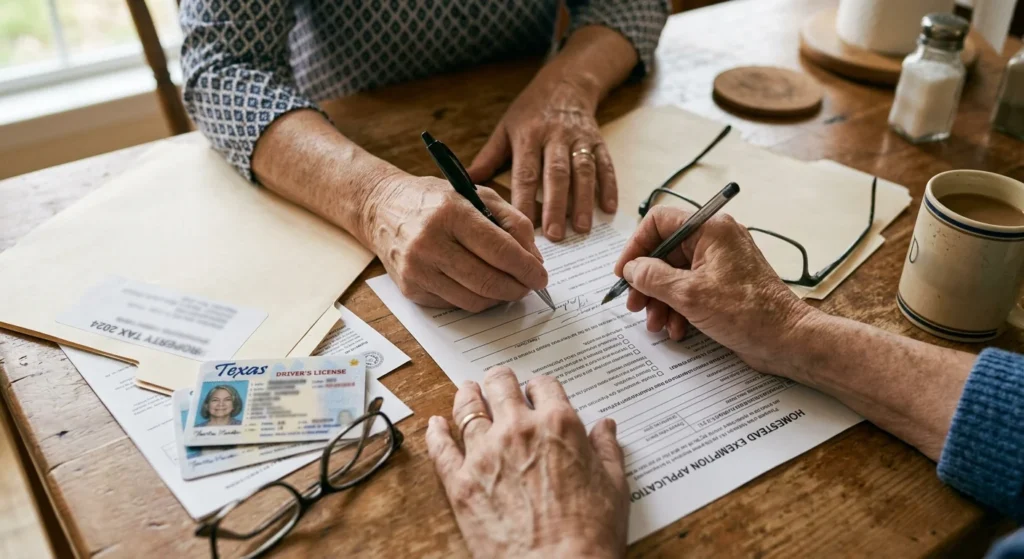
- Gather proof of age and residence, usually a driver’s license or state ID showing your home address, and sometimes a deed.
- File before the deadline. In Texas, the usual cutoff is April 30, and other states set their own dates.
- Renew if required. Income-tested programs often need yearly proof.
- Tell your mortgage servicer once the exemption is approved, since lower taxes should reduce your escrow payment.
Check These Details Before Moving for a Lower Bill
A lower property tax is one piece of your total cost. Sales tax, income tax on pensions, homeowners insurance, and home prices can outweigh a senior exemption, so compare the full picture for any state you are considering.
Rules also change. Texas voters raised the over-65 exemption from $10,000 to $60,000 in 2025, so guides written a year earlier are now wrong. Freezes and exemptions tend to be tied to a specific home, so moving usually means reapplying in the new county.
Alabama and Texas come closest, but the answer for any one household still depends on its county, income, and home value. Call the local assessor with your address before planning a move around a tax break.