


Yes, in most of the United States, a landlord can raise your rent by $300, but only if the increase respects your lease, comes with the notice your state requires, and stays under any local rent cap. No federal law limits how much a private landlord can charge. Whether your increase is legal depends on where you live, what kind of lease you have, and how much you pay now.
That last point matters more than most people expect. A $300 jump on a $3,000 apartment is a 10% change, while the same jump on a $1,000 apartment is 30%. This guide covers the rules, the math, and the steps to take before you sign or move out.
The Short Answer: Usually Yes, Under Four Conditions
Landlords can generally raise rent when a fixed-term lease ends or when you rent month to month. What they cannot do is raise it at any moment, by any amount, with no warning. A $300 increase is legal when four conditions are met.
Your lease term has ended, or you have a month-to-month agreement. The landlord gave written notice within the time your state requires. No state or local cap applies, or the increase fits under it. The timing is not a punishment for something you did, such as reporting unsafe conditions.
If one of those conditions fails, the increase may be invalid, and you have room to push back. The rest of this guide shows how to check each one.
What Federal Law Says About Rent Increases
No federal law caps rent on private residential rentals. The federal Fair Housing Act, passed in 1968, bars landlords from changing rental terms because of race, color, religion, sex, national origin, familial status, or disability, according to the Department of Housing and Urban Development (HUD). Federal law polices discrimination, not price.
Tenants in subsidized housing have extra protection. If you use a Housing Choice Voucher, the owner generally has to request a rent increase, and the local housing authority decides whether the new amount is reasonable. Everything else about amounts and notice comes from state and local law.
Is a $300 Increase Reasonable? Check the Percentage First
A flat dollar amount tells you little. What matters is the share of your current rent it represents. Divide 300 by your monthly rent to find out.
| Current Monthly Rent | A $300 Increase Equals |
| $1,000 | 30% |
| $1,200 | 25% |
| $1,500 | 20% |
| $2,000 | 15% |
| $2,500 | 12% |
| $3,000 | 10% |
Where caps exist, the ceiling is usually 10% a year or lower. By that yardstick, a $300 increase fits under a 10% cap only if your rent is $3,000 or more. A tenant paying $1,500 is looking at a 20% jump, which would be illegal in a capped state.

Outside capped areas, a large increase is still legal, but it is also negotiable. Landlords often prefer a smaller increase over the cost of vacancy, turnover, cleaning, and re-listing the unit. Pull up three or four current listings for similar apartments nearby before you reply.
If market rent supports the $300, you have less leverage. If it does not, you have a concrete argument.
Why Landlords Raise Rent by $300
Landlords usually point to higher property taxes, insurance premiums, repair costs, or market rents. These reasons explain the motive, but in most states they are not a legal requirement. Outside rent-controlled areas, a landlord does not have to justify an increase at all.
In some capped or just-cause jurisdictions, though, the landlord may need to show the increase fits within the rule. Asking for the reason in writing costs you nothing and can show whether the number is negotiable.
Can a Landlord Raise Rent in the Middle of a Lease?
Usually not. A fixed-term lease, such as a 12-month lease, sets your rent for the whole term. The landlord cannot add $300 in month five because the market moved.
There are exceptions. Some leases include an escalation clause that raises rent on a set date or by a set formula. Read your lease for words like escalation, adjustment, or renewal rent. If the clause is there, the increase may be valid even mid-term.
If no such clause exists, you can decline the change. Keep paying the agreed rent in full and on time, and send a short written reply that cites the lease. Do not stop paying or withhold rent without advice from a local legal aid office, because that can trigger an eviction case.
When the lease expires, the picture changes. The landlord can offer a renewal at a higher rent, and you can accept, negotiate, or leave. In many states, a lease that runs out without a new agreement turns into a month-to-month tenancy, which opens the door to a notice-based increase.
How Much Notice Must a Landlord Give?
Notice rules differ by state, and an increase delivered with too little notice may not take effect on the date your landlord chose.
Month-to-Month Tenants
Most states require at least 30 days of written notice before a month-to-month increase starts. Some require more for larger increases or longer tenancies. A text message or a casual comment in the hallway may not count, since many states require written notice delivered in a specific way.
Examples From Four States
California requires 30 days of notice for an increase of 10% or less and 90 days for anything above 10% (California Civil Code Section 827). Washington requires 90 days of written notice under RCW 59.18.140. Oregon requires 90 days after the first year of tenancy under ORS 90.323.
In New York, for increases of 5% or more, notice runs 30, 60, or 90 days depending on how long you have lived in the unit. Notice periods change as legislatures revise tenant laws, so confirm the current rule on your state attorney general’s or housing agency’s website.
States and Cities That Cap Rent Increases
Only a handful of states cap increases statewide, and the rules carry exemptions. If you live in one, a $300 increase may be illegal on its face.
1. California
California’s Tenant Protection Act (AB 1482) limits annual increases to 5% plus the local change in the Consumer Price Index, with a ceiling of 10% in any 12 months. It covers many rentals in buildings more than 15 years old. Some single-family homes and condos owned by individuals are exempt when the landlord gives proper written notice.
The statute is set to expire in 2030. Cities such as Los Angeles, San Francisco, and Oakland have their own, sometimes stricter, ordinances. If you pay $2,400, the maximum 10% increase is $240, so a $300 increase would be over the line.
2. Oregon and Washington
Oregon was the first state with a statewide cap, passed in 2019. Under the current version, annual increases are limited to 7% plus CPI, capped at 10%, and the state publishes the exact maximum each year. Buildings less than 15 years old are exempt.
Washington passed a similar law in 2025, with a limit of 7% plus inflation or 10%, whichever is lower.
3. New York
New York’s Good Cause Eviction law, which took effect in 2024, limits increases to the lower of 5% plus CPI or 10% for covered apartments. Many units are exempt, including some owned by small landlords. Rent-stabilized apartments follow separate increases set by rent boards, such as the New York City Rent Guidelines Board.
4. Local Rent Control and State Bans
Some cities, including Washington, D.C., and several in New Jersey and Maryland, run their own rent control programs. Other states go the opposite direction. Texas and Florida restrict cities from adopting rent control.
Search your city name with “rent control” or “rent stabilization” to see whether an ordinance applies to your building.
When a $300 Increase Is Illegal Even Without a Cap
A rent increase can fail for reasons that have nothing to do with the amount.
1. Retaliation
Most states protect tenants from increases meant as payback for exercising their rights, such as complaining to a housing inspector, requesting repairs, or joining a tenant group. California Civil Code Section 1942.5, for example, prohibits retaliatory rent increases within 180 days of a protected action. If your notice arrived soon after you reported a problem, save the dates, emails, and photos.
2. Discrimination
An increase aimed at one tenant because of a protected trait, or because a tenant has children, violates the Fair Housing Act. If neighbors in similar units received a much smaller increase, write down what you learn. You can file a complaint with HUD or a state fair housing agency.
3. Defective Notices and Subsidized Units
A notice that arrives late, skips required details, or comes in the wrong form can be challenged. If you receive a voucher or live in a regulated unit, the landlord cannot simply send a letter, because the increase usually needs agency approval first.
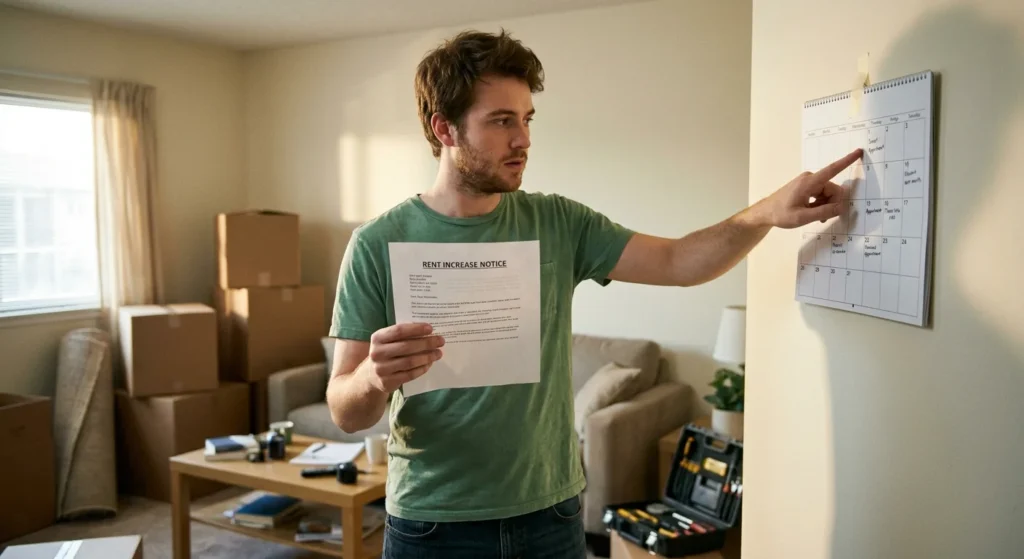
What to Do After Receiving a $300 Rent Increase Notice
Do not sign anything or reply in anger. A calm plan works better.
1. Read the Notice and Your Lease
Confirm the effective date, the new amount, and how the notice was delivered. Count the days from delivery to the effective date and compare that to your state’s rule. Then check your lease for renewal terms or an escalation clause.
2. Check for Caps and Exemptions
Search your city and state for rent control or rent stabilization rules. If a cap applies, calculate the percentage and compare. Ask the landlord to confirm in writing whether the unit is exempt and why.
3. Negotiate With Facts
Send a polite written reply. Mention how long you have lived there, your payment history, and nearby listings for comparable units. Ask for a smaller increase, a phased increase, or a longer lease at a lower figure.
A landlord who values a reliable tenant will often counter.

4. Plan for the Worst Case
If the increase stands and you cannot afford it, decide early. Compare moving costs, such as deposits, movers, and overlapping rent, against the extra $3,600 a year that a $300 monthly increase adds up to. Start searching before your notice period ends, since good listings move quickly.
If you are struggling to pay, local rental assistance programs and legal aid offices can help.
Where to Find Free Help
LawHelp.org lists free legal aid programs by state. The Legal Services Corporation website has a locator for federally funded legal aid offices. HUD’s website offers state-by-state tenant rights information, and your state attorney general’s office usually publishes a landlord-tenant guide.
This article gives general information, not legal advice, and local rules change often. A tenant attorney or housing counselor can review your lease and notice. Whether a $300 increase stands comes down to your lease, your notice, and your local cap, so check those three before you answer.