


So, how do you get pre approved for a home loan? You apply with a mortgage lender, hand over proof of your income, assets, and debts, and let the lender pull your credit. If your numbers hold up, you receive a letter stating how much the lender is willing to loan you, usually good for 60 to 90 days.
With organized paperwork, most buyers finish the process in a few days. The steps below cover what to do first, what lenders look for, and where buyers trip up.
What Pre Approval Means Before You Start
A pre approval is a lender’s conditional commitment, based on verified documents and a hard credit check, to lend you up to a certain amount. It is not a final loan approval. The lender still has to appraise the home, review the title, and confirm that nothing in your finances changed.
Prequalification vs. Pre Approval
Prequalification is a rough estimate built on numbers you report yourself, often with no credit pull. Pre approval involves documents and verification, which is why sellers and listing agents take it seriously. The Consumer Financial Protection Bureau (CFPB) notes that lenders do not use these terms consistently, so ask what the lender actually checked before you rely on a letter.
Step 1: Check Your Credit Before a Lender Does
Pull your reports from all three bureaus at AnnualCreditReport.com, the federally authorized free source, and read them line by line. Look for accounts you do not recognize, wrong balances, and late payments reported in error. Disputes can take 30 days or longer to resolve, so start early.
Then look at your credit card balances. Lenders see the balance reported on your statement date, not what you pay off later. Paying a card down before the statement closes can lift your score and lower your reported debt at the same time.
Step 2: Know the Numbers Lenders Care About
1. Credit Score Minimums by Loan Type
Minimums differ by program. Fannie Mae sets a 620 floor for most conventional fixed-rate loans. The Federal Housing Administration (FHA) allows a 3.5% down payment with a 580 score, and scores from 500 to 579 need 10% down, according to HUD.
VA loans have no government-set minimum, so each lender picks its own cutoff. Many lenders look for around 640 on USDA loans.
Meeting the minimum is not the same as getting a good rate. Higher scores generally earn lower pricing, so a 740 and a 640 can produce very different monthly payments on the same loan.
2. Debt-to-Income Ratio
Your debt-to-income (DTI) ratio is your monthly debt payments, including the new mortgage, divided by your gross monthly income. Fannie Mae’s automated underwriting can approve ratios up to 50%, though many lenders prefer 43% or lower. The old 43% cap in the federal Qualified Mortgage rule was replaced with a pricing-based test, but 43% is still a common benchmark.
Here is a simple example. Say you earn $6,500 a month before taxes and owe $600 a month on a car loan and student loans. At a 43% ratio, your total monthly debt tops out near $2,795, which leaves about $2,195 for the full housing payment.
That housing payment covers principal, interest, property taxes, homeowners insurance, and any HOA dues. Many first-time buyers only count the first two.
3. Down Payment and Reserves
Conventional loans can start at 3% down and FHA loans at 3.5%. VA and USDA loans can require nothing down for eligible borrowers. Putting less than 20% down on a conventional loan usually means paying private mortgage insurance.
Lenders also check that you have cash beyond the down payment and closing costs. Those leftover funds are called reserves, and the amount required varies by lender and loan type.
Gift money is allowed on many programs. Expect to provide a signed gift letter and a paper trail showing where the money came from.
Step 3: Gather Your Documents
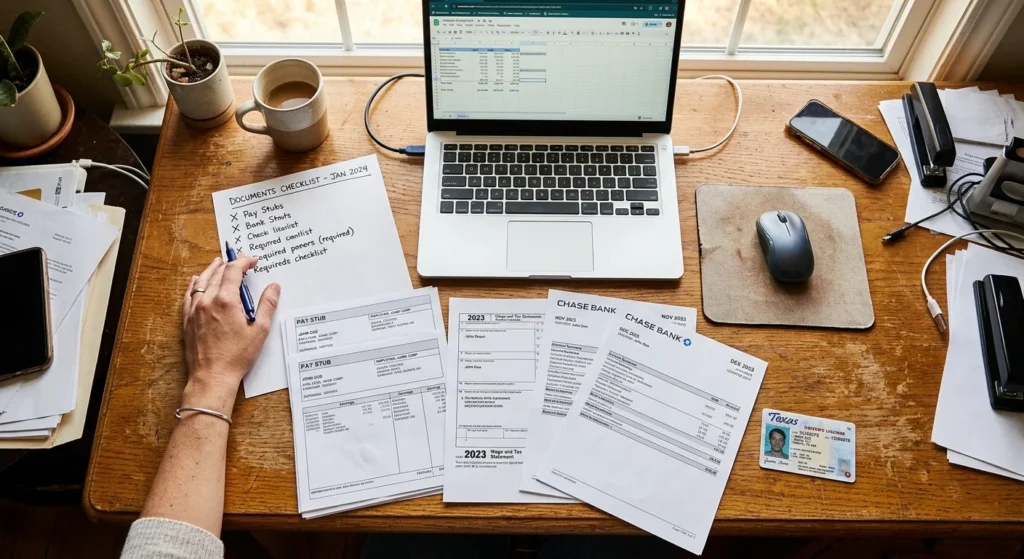
Paperwork is the biggest factor in how fast approval moves. Most lenders ask for the following:
- Government-issued photo ID and your Social Security number
- Pay stubs covering the last 30 days
- W-2 forms from the past two years
- Federal tax returns from the past two years
- Two months of statements for checking, savings, and investment accounts
- A list of your monthly debts, plus a signed gift letter if someone is helping with the down payment
Self-employed buyers face a longer list. Expect to provide two years of personal and business tax returns, and often a year-to-date profit and loss statement. Lenders usually average your net income over two years, so a recent decline can lower the amount you qualify for.
If bonuses or commission make up a large share of your pay, lenders generally want a two-year history of that income too.
Step 4: Compare Lenders and Apply Inside One Window
Apply with at least three lenders, such as a large bank, a credit union or local lender, and an online lender or mortgage broker. The CFPB explains that mortgage inquiries made within a short stretch are treated as a single inquiry for scoring, with the window running from 14 to 45 days depending on the scoring model. Keeping every application within 14 days is the safe move.
Ask each lender for a written quote showing the rate, points, and fees, so you can compare them side by side. A slightly lower rate can come with higher upfront costs, and the cheaper offer is not always the one with the lowest rate.

Once you have a home under contract and formally apply, the lender must send a Loan Estimate within three business days. That form lays out the rate, monthly payment, and closing costs in the same format for every lender.
Step 5: Review Your Pre Approval Letter
After underwriting reviews your file, which can take anywhere from a few hours to a few days, the lender issues a letter. It lists the loan amount, loan type, and expiration date, and often names conditions. Read the conditions closely.
Items like “subject to appraisal” or “subject to updated pay stub” are normal, but they tell you what still has to happen. Ask your lender whether they can also issue a version showing the exact price of the home you want to offer on.
Your Pre Approval Amount Is a Ceiling, Not a Budget
Lenders approve what the ratios allow, not what fits your life. A letter for $400,000 says nothing about childcare costs, a long commute, or the savings goals you set. Write out your monthly spending, decide on a payment you can carry comfortably, and give your agent that number.
Property taxes and insurance differ sharply by state and county, and they change your payment more than many first-time buyers expect. Ask your agent for the tax bill and an insurance quote on any home you tour. Mortgage rates move daily, so a payment estimate from last month may already be off.
How Long a Pre Approval Lasts
Most letters stay valid for 60 to 90 days, and some lenders set a shorter period. After that, the lender typically refreshes your credit report and asks for updated pay stubs and statements. If your search runs long, a renewal is usually simpler than starting over, though it may involve another credit check.
A pre approval does not lock your interest rate. A rate lock comes later, once you have a contract on a home, and lock periods and costs vary by lender.
Mistakes That Can Undo Your Approval
Lenders often check your credit and employment again right before closing. Changes between pre approval and closing can derail a loan that looked solid. These are the most common ones to avoid:
- Opening a new credit card or financing a car or furniture
- Switching jobs, especially into a new field or to commission pay
- Moving large sums between accounts without a record of why
- Missing a payment on any existing account
- Co-signing a loan for someone else
Large deposits that did not come from payroll need a written explanation, so keep records of any money you move. If you must change jobs or take on debt, call your loan officer first.

Special Situations Worth Planning For
Veterans and active-duty service members need a Certificate of Eligibility for a VA loan, which many lenders can retrieve online. First-time buyers can ask about down payment assistance through their state housing finance agency, since some programs require a participating lender.
Buyers with a thin credit history can ask about manual underwriting, where the lender looks at rent and utility payment records instead of relying on a score. Not every lender offers it, so ask before you apply.
This article is general information, not financial or legal advice. Loan requirements, rates, and limits change, so confirm details with a licensed loan officer before you apply.