


A real estate practice exam is a set of sample questions built to mirror the topics, format, and difficulty of the actual licensing test you’ll take to become an agent or broker. Working through one before test day helps you find weak spots while there’s still time to fix them, instead of finding out at the testing center.
Most states split the real exam into a national portion and a state-specific portion, so a solid practice exam should cover both. Below is what that structure looks like, what to expect on test day, how the free and paid versions of a practice exam typically differ, and how to use practice questions so they actually move your score.
Why a Real Estate Practice Exam Matters
Completing a pre-licensing course does not automatically prepare you for the exam format. Course material is built around teaching concepts, while the real exam tests how well you can apply those concepts under timed, multiple-choice conditions, often with tricky wording designed to catch a half-understood topic.
Practice exams close that gap. They train you to read a question the way the exam actually asks it, not the way a textbook explains it. They also build the stamina to sit through 100 or more questions in one sitting without losing focus in the last section
Free vs. Paid Real Estate Practice Exams
A free real estate practice exam is usually enough to get a feel for the question style and to gauge where you stand early on. Most free versions offer a limited question bank, a basic score at the end, and sometimes only cover the national portion, leaving the state-specific section thinner.
Paid practice exam packages typically add a much larger question pool, video lessons that walk through the reasoning behind tricky topics, and category-specific quizzes built around your weakest areas instead of a single generic run-through. Some also include live webinars where you can ask an instructor about a concept you keep missing.
Neither option guarantees a pass on its own. The free version is a reasonable starting point if you’re early in your studying, and a paid package earns its cost mainly if you’ve already tried the free questions and are still missing the same categories on repeat attempts.
How the Real Estate Licensing Exam Is Structured
Nearly every state divides the exam into two parts: a national portion covering concepts common to real estate practice everywhere, and a state portion covering that state’s specific license law. A handful of states, including California and New York, combine both into a single section instead of scoring them separately.
The exam itself is computer-based and multiple-choice, administered at a testing center through a third-party vendor such as PSI, Pearson VUE, or AMP, depending on the state. You’ll typically get your pass or fail result the moment you finish, though most vendors don’t show your exact score if you pass, only if you fail. Expect to bring a government-issued photo ID and leave personal notes, phones, and study materials outside the testing room, since most centers only allow a basic calculator provided or approved on-site.
What a Good Real Estate Practice Exam Should Include
Not all practice questions are created equal. A practice exam worth your time should include a full-length simulation that matches the real question count, category-specific quizzes so you can drill your weakest topics, and a written explanation for every answer, not just a right-or-wrong marker.
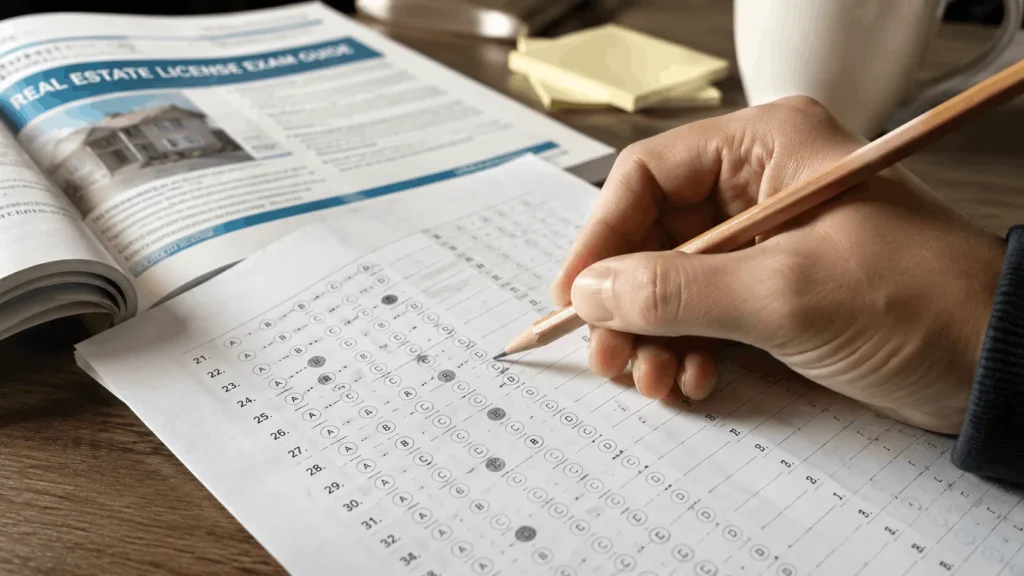
Explanations matter more than the score itself. Getting a question wrong without understanding why teaches you nothing, while a clear explanation turns one missed question into a concept you now actually know
Topics Covered on the National Portion
The national portion draws from the same core subject areas no matter where you’re testing. These five categories make up most of the question bank.
Property Ownership and Land Use
Expect questions on types of ownership, easements, liens, encroachments, and government land-use controls like zoning. This category also covers the difference between freehold and leasehold estates.
Contracts and Agency
This section covers listing agreements, bilateral versus unilateral contracts, and the duties an agent owes a client under a fiduciary relationship. Agency creation and termination show up often here.
Financing
Questions here focus on loan types, the mortgage process, and terms like amortization and points. You don’t need to be a loan officer, but you do need to recognize the vocabulary.
Valuation and Appraisal
This covers the approaches used to estimate a property’s value, including the market data approach and the cost approach, along with the basics of depreciation.
Real Estate Practice and Disclosures
Fair housing law, truth-in-advertising rules, and required disclosures live in this category. It also covers practices the exam specifically flags as prohibited, such as steering and blockbusting.
Real Estate Math You’ll See on Practice Exams
Math questions are usually a smaller slice of the exam than vocabulary, but they trip up more test takers because they require a process instead of a memorized definition. Common problem types include commission splits, property tax proration, loan-to-value ratios, and area calculations for square footage or acreage.
Take a commission split question as an example. If a home sells for $300,000 and the total commission is 6%, split evenly between the listing and buyer’s agents, and your brokerage then takes a 30% cut of your half, you need three separate calculations chained together before you land on your final number. Miss one step and the whole answer is wrong, even if you understood the concept.
The fix is repetition, not formulas memorized the night before. Work through math problems on a real estate practice exam until the steps become automatic, since the exam won’t give you extra time to work out a process you’re seeing for the first time
How Many Questions and What Score You Need
Question counts and passing scores are set by each state’s real estate commission, so they vary more than most candidates expect. The table below shows how much that range can shift from one state to the next, based on published state exam breakdowns.
| State | Total Questions | National / State Split | Passing Score |
| Texas | 125 | 85 national / 40 state | 56 national / 21 state |
| Illinois | 140 | 100 national / 40 state | 75% scaled score |
| Pennsylvania | 110 | 80 national / 30 state | 60 national / 23 state |
| Ohio | 120 | 80 national / 40 state | Varies by scaled score |
| California | 150 | Combined, single section | 70% |
| New York | 75 | Combined, single section | 70% |
Most states land somewhere around 70 to 75% correct to pass, whether shown as a raw score or a scaled score. Always confirm the current number with your state’s real estate commission, since these thresholds do get revised.
How to Use Practice Exams Effectively
Take a full-length practice exam early, before you’ve studied much, so you know your real starting point instead of guessing at it. Retake category-specific quizzes until you consistently score 80% or higher in that category, then move to the next weak spot.

Time yourself the way the real exam will. Most testing vendors give roughly 90 seconds to two minutes per question, and building that pace into practice now prevents a rushed, panicked finish on test day. Review every explanation, including the ones you got right, since a lucky guess on a topic you don’t actually understand will show up again
What Happens If You Don’t Pass
A failed attempt is not unusual, and states plan for it. Most allow multiple retakes within a set window, often two to three attempts, before requiring extra pre-licensing hours. Texas, for example, allows three attempts before requiring 30 additional hours of coursework, while Pennsylvania allows unlimited retakes but charges the exam fee again each time.
Whatever your state’s rule, the fastest path back is reviewing exactly which categories you missed. Restarting your studying from scratch wastes time you don’t need to lose. Most testing vendors provide a category-level breakdown on a failed attempt, and that breakdown is the most useful study guide you’ll get.
Real Estate Practice Exam vs. the Real Licensing Exam
A practice exam and the real exam test the same material, but the experience is not identical. Practice questions come with explanations, can be retaken instantly, and let you study by category. The real exam is proctored, timed strictly, gives you a pass or fail result with no explanations, and typically restricts what you can bring into the testing room beyond a basic calculator and photo ID.
Treat the practice exam as training and the real exam as the event itself. If you can consistently score well above your state’s passing threshold on full-length practice tests under timed conditions, you’re testing the skill the exam is actually built to measure, not just your memory of a single lucky run.