

A real estate commission calculator multiplies your home’s sale price by the agreed commission rate to show exactly how much your agent (and their brokerage) will collect at closing. On a $400,000 home at a typical 5 to 6 percent rate, that works out to $20,000 to $24,000 split between the listing side and the buyer’s side.
Below is the exact formula behind the calculator, worked examples at different price points, and a breakdown of how that fee gets divided once it leaves the closing table.
How to Use a Real Estate Commission Calculator
You only need two numbers to run the calculation: the property’s final sale price and the commission rate written into the listing agreement. Enter both, and the calculator returns the total commission dollar amount, then splits it between the listing agent’s side and the buyer’s agent’s side if you want that detail too.
Some calculators also let you factor in closing costs or a brokerage split, which turns the tool from a simple commission calculator into a rough net proceeds estimate. That extra step matters if you’re a seller trying to figure out what actually lands in your bank account, not just what the agents are paid.
Real Estate Commission Formula
The math behind every real estate commission calculator is the same, whether you’re pricing a $200,000 condo or a $2 million estate.
Commission = Sale Price x (Commission Rate / 100)
Example Calculation
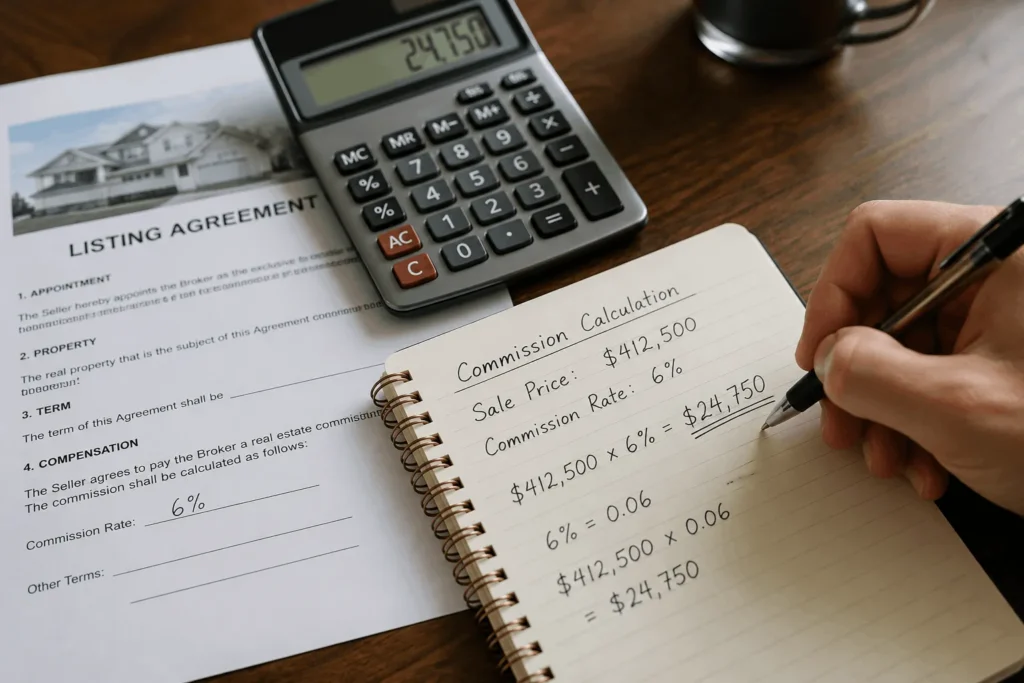
Say a home sells for $450,000 and the listing agreement sets a 5.5 percent total commission. Multiply $450,000 by 0.055 and you get $24,750. That figure typically covers both the seller’s agent and the buyer’s agent, before either side splits their cut with a brokerage.
If you’d rather work it out by hand than plug numbers into a tool, divide the rate by 100 first to convert it to a decimal, then multiply. A 6 percent rate becomes 0.06, a 4.5 percent rate becomes 0.045, and so on.
What Is the Average Real Estate Commission Rate
Most residential sales in the U.S. still land in the 5 to 6 percent range for the combined commission, though that figure has been trending down for years and varies by state, brokerage, and how competitive the local market is. In slower markets or on higher-priced homes, agents are often more willing to negotiate down to 4 or 4.5 percent because the dollar amount stays worthwhile even at a lower rate.
Discount brokerages and flat-fee listing services have also pushed rates lower in many metro areas, sometimes offering listing-side representation for 1 to 2 percent instead of the traditional 2.5 to 3 percent. None of these rates are set by law or by any industry body. Every commission is a private negotiation between a seller and their agent.
Who Actually Pays the Real Estate Commission
Technically, the seller signs the check. The commission gets deducted from the sale proceeds at closing before the remaining balance is wired to the seller.
In practice, that fee is baked into the home’s asking price the same way property taxes or a mortgage payoff are, so buyers cover it indirectly through what they pay for the house. This is one reason the math in a commission calculator matters more to sellers than buyers: it’s the seller’s net proceeds that shrink by that dollar amount, not a separate bill the buyer receives.
Since the 2024 NAR settlement changes took effect, buyers are more likely to negotiate their agent’s fee directly rather than assume it rides along with the seller’s listing agreement. In some deals, buyers now cover part or all of their own agent’s commission out of pocket, or ask the seller to credit that amount as a concession during negotiations. Either way, the total dollar figure a commission calculator produces doesn’t change. What’s shifted is which line item on the closing statement it shows up under.
How Commission Splits Between Agents and Brokerages
The total commission rarely goes to one person. A $24,000 fee on a $450,000 sale, split 50-50 between the listing side and buyer’s side, gives each side $12,000. From there, each agent typically splits their half again with their brokerage.
A common structure looks like this:
Total commission: $24,000
Listing agent’s side: $12,000, often split 60-70 percent to the agent and the rest to the brokerage
Buyer’s agent’s side: $12,000, split under a similar structure
Agent’s actual take-home: roughly $7,200 to $8,400 per side, before taxes and business expenses
New agents on a lower commission cap with their brokerage often keep less than half of their side of the split. Experienced agents who’ve hit their brokerage’s annual production cap sometimes keep 100 percent, paying only a flat transaction fee instead of a percentage.

What Changed After the 2024 NAR Settlement
In 2024, the National Association of Realtors settled a set of antitrust lawsuits over how commissions were disclosed and offered. As part of that settlement, buyer’s agent commission offers can no longer be published directly on the MLS, and buyers now typically sign a written agreement with their agent before touring homes, spelling out how that agent gets paid.
The math a commission calculator runs hasn’t changed. Sellers still negotiate a listing fee, and that fee is still split between both sides in most transactions. What’s changed is that buyer’s agent compensation is now negotiated more explicitly and separately, rather than assumed as a fixed percentage baked into every listing.
Factors That Affect Your Commission Rate
A handful of variables move the rate a calculator should use before you even start negotiating.
Property price plays a role, since agents are often more flexible on percentage for expensive homes where the dollar total stays high. Local market conditions matter too. In a seller’s market with low inventory, agents sometimes hold firmer on rate because homes are moving quickly with less marketing effort required.
The level of service you’re asking for also factors in. A full-service listing with professional photography, staging consultation, and open houses costs more than a bare-bones MLS listing through a flat-fee broker. And an agent’s experience and track record in your specific neighborhood can justify a higher rate if it means a faster sale at a better price.
How to Negotiate a Lower Commission
Ask more than one agent for a listing presentation before signing anything, since rates vary by brokerage and by how badly an agent wants your listing. Bringing your own buyer to the table, such as a friend or relative, can also justify a lower rate since the agent’s marketing workload drops.
Bundling a purchase and a sale with the same agent is another common lever. Many agents will shave a percentage point off one side of a deal if they’re getting paid on both your sale and your next purchase.
Timing helps too. Agents are often more willing to negotiate at the end of a slow month or quarter when they’re trying to hit a personal or brokerage sales goal. It’s also worth asking exactly what drops off the service list if you push for a lower rate. A cut in commission sometimes means fewer showings, less professional photography, or a smaller marketing budget, and it’s better to know that trade-off upfront than to find out after you’ve signed.
Is Real Estate Commission Tax Deductible
Commission isn’t deducted from your taxable income the way a business expense would be, but it still reduces what the IRS considers your taxable gain on the sale. Selling costs, including agent commission, title fees, and transfer taxes, get subtracted from your sale price to arrive at the “amount realized,” which is then compared against your cost basis to calculate profit.
For most primary residence sales, that profit falls under the capital gains exclusion (up to $250,000 for single filers and $500,000 for married couples filing jointly, assuming you meet the ownership and use tests), so the commission deduction only becomes relevant if your gain exceeds that threshold. Investment property sellers see a more direct benefit, since commission lowers taxable gain on every sale regardless of exclusion limits. This is general guidance, not tax advice. Check with a licensed tax professional before filing based on any of these numbers.
Commission at Different Sale Prices and Rates
Here’s how the same formula plays out across a range of home prices and commission rates.
Sale Price 5% Commission 5.5% Commission 6% Commission
$250,000 $12,500 $13,750 $15,000
$400,000 $20,000 $22,000 $24,000
$600,000 $30,000 $33,000 $36,000
$900,000 $45,000 $49,500 $54,000

Commission vs. Other Closing Costs
Commission is usually the largest single closing cost a seller pays, but it isn’t the only one. Sellers also typically cover title insurance, transfer taxes, any agreed-upon buyer concessions, and their share of prorated property taxes.