


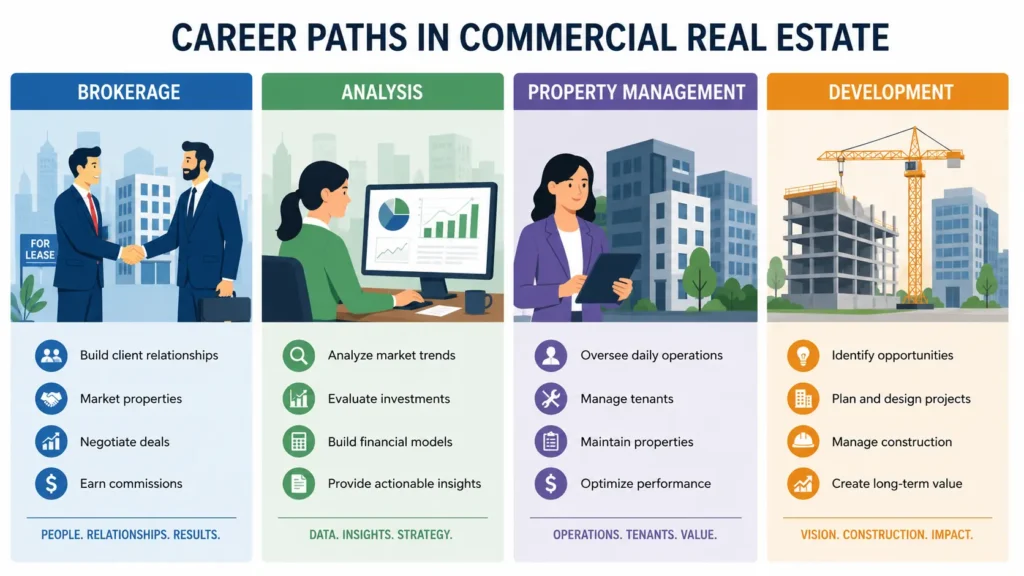
Getting into commercial real estate rarely happens through a single job posting. Most people find their way in through one of several distinct paths: brokerage, analysis, property management, development, or direct investing. Each path has its own entry requirements, income timeline, and skill set, and picking the wrong one for your background can cost you years.
This guide breaks down the real routes people use to enter commercial real estate in the United States, what licensing actually requires, and how to land your first role or deal without wasting time on advice that only applies to residential agents.
What Commercial Real Estate Actually Involves
Commercial real estate covers any property used for business purposes rather than housing a single family. That includes office buildings, retail centers, industrial warehouses, multifamily apartment complexes with five or more units, hotels, and specialized assets like self-storage or data centers. Each asset class runs on different lease structures, financing terms, and buyer profiles, which is why specialists tend to pick one or two and go deep rather than spreading thin across all of them.
1. How It Differs From Residential Real Estate
Residential deals are driven mostly by emotion and personal preference. Commercial deals are driven by numbers. A retail landlord cares about net operating income, cap rate, and tenant creditworthiness far more than curb appeal. Transactions take longer, often six months to over a year, and involve far more parties: lenders, appraisers, environmental consultants, and sometimes institutional investors. Commissions are larger per deal, but deal volume is lower, which changes how income actually flows for people new to the field.
The Main Paths Into Commercial Real Estate
There is no single correct entry point. The right one depends on your current background, how much capital you have access to, and whether you want to earn commissions, a salary, or ownership in property itself.
1. Becoming a Commercial Real Estate Broker or Agent
Brokerage is the most common entry point because it has the lowest financial barrier. You get licensed, join a firm, and start prospecting for listings and buyers. Income is commission-based and can take twelve to eighteen months to become consistent, so most new brokers need savings or a part-time income source while they build a pipeline. Firms like CBRE, JLL, Cushman & Wakefield, and Marcus & Millichap regularly hire junior brokers and pair them with senior producers for mentorship.
2. Working as a Commercial Real Estate Analyst
Analyst roles suit people with a finance, accounting, or economics background who want a salaried entry point instead of commission risk. Analysts build financial models, underwrite deals, and support acquisitions teams at brokerages, private equity firms, REITs, or lenders. This path is common for people coming straight out of undergraduate finance programs and offers a clearer, faster route to understanding deal mechanics than brokerage does.
3. Property Management as an Entry Point
Property management is underrated as a starting point because it teaches you the operational side of commercial real estate that brokers and investors often lack. Managing tenant relationships, lease renewals, maintenance budgets, and building operations gives you a ground-level understanding of what actually drives a property’s income. Many successful investors and developers started their careers managing buildings before moving into acquisitions.
4. Real Estate Development
Development is the hardest path to break into directly but offers the highest long-term upside. Entry usually happens through a development firm as a project coordinator or development analyst, working under experienced developers on entitlement, construction budgeting, and lease-up. This path requires patience since single projects can take years from land acquisition to stabilized income.
5. Investing Directly in Commercial Property
Some people skip employment entirely and go straight to buying property, usually starting with a small multifamily building or a single retail unit using a combination of personal savings, a commercial loan, and sometimes a partner who brings capital. This path carries real financial risk and works best for people who already understand underwriting, either from a prior career or from serious self-education before committing money.
Do You Need a License to Get Into Commercial Real Estate?
1. State Licensing Requirements
Yes, if you plan to broker, list, or negotiate commercial property transactions on behalf of others, you need a real estate license in the state where you operate. Requirements vary by state but generally include completing a set number of pre-licensing course hours, usually between 40 and 180 depending on the state, passing a state exam, and working under a licensed broker for a set period before you can operate independently. States like Texas, Florida, and California each have their own hour requirements and renewal cycles, so check your specific state’s real estate commission before enrolling in a course.
2. Working Without a License
You do not need a license to work as an analyst, property manager, developer, or direct investor buying property for your own account. Licensing only becomes mandatory when you are transacting on behalf of another party for compensation. This is why many people enter commercial real estate through analyst or management roles first and get licensed later if they decide to move into brokerage.
Education and Certifications That Help
1. Degrees Worth Considering
A degree is not required to get into commercial real estate, but certain backgrounds make entry noticeably easier. Finance, economics, accounting, and real estate degree programs give you the underwriting vocabulary firms expect on day one. Several universities, including NYU, USC, and the University of Wisconsin, run dedicated real estate finance programs that lead directly into analyst and acquisitions roles.
2. Industry Certifications (CCIM, SIOR, etc.)
Once you are working in the field, certifications add credibility and often accelerate promotions. The CCIM designation (Certified Commercial Investment Member) is the most recognized credential for brokers and investors and focuses heavily on financial analysis and negotiation. SIOR (Society of Industrial and Office Realtors) is respected specifically within industrial and office brokerage. Neither is required to start, but both matter for long-term career growth and client trust.
Building the Skills Commercial Real Estate Requires
1. Financial Analysis and Underwriting
Every serious commercial real estate role depends on your ability to read a rent roll, calculate net operating income, and evaluate whether a deal’s cap rate justifies its risk. If you cannot build a basic pro forma in Excel, this is the single highest-leverage skill to learn before applying anywhere. Free resources and paid courses on real estate financial modeling can get you competent within a few weeks of focused study.
2. Negotiation and Relationship Building
Commercial real estate is a relationship business more than a transactional one. Brokers who succeed long term are the ones tenants and owners call first when they have a need, not just the ones who cold-call the hardest. Building genuine relationships with property owners, lenders, attorneys, and other brokers compounds over years and eventually becomes your main source of deal flow.

How to Break In With No Experience
1. Entry-Level Roles to Target
If you have no industry background, target roles explicitly labeled analyst, broker associate, leasing coordinator, or property management assistant. These roles hire based on aptitude and work ethic rather than years of experience, and they put you inside deal flow immediately. Reach out directly to mid-size regional brokerages, not just the national giants, since they often have less competition for entry-level seats.
2. Networking That Actually Works
Join your local chapter of organizations like NAIOP or the Urban Land Institute, attend their events consistently, and follow up individually with people you meet rather than collecting business cards passively. Commercial real estate hiring runs heavily on referrals, and showing up repeatedly at the same industry events builds the familiarity that gets you considered for openings before they are ever posted publicly.
Raising Capital and Getting Your First Deal
1. Syndications and Partnerships
If your goal is ownership rather than brokerage, real estate syndications let you participate in larger deals without funding the entire purchase yourself. A sponsor finds and manages the property while investors contribute capital in exchange for a share of returns. Getting into a syndication as a passive investor is a common way to learn deal structure before attempting to sponsor a deal yourself.
2. REITs and Crowdfunding as a Lower-Barrier Start
Publicly traded REITs and online crowdfunding platforms let you gain exposure to commercial real estate with far smaller amounts of capital than a direct purchase requires. While this will not teach you brokerage or management skills, it is a legitimate way to start building familiarity with how commercial property performs as an asset class before committing to a full career change.
What Income Looks Like Starting Out
Analyst salaries typically start in the range firms advertise for entry-level finance roles in a given metro area, with meaningful upside through bonuses tied to deal activity. Broker income is far less predictable in year one, since it depends entirely on closed transactions, but experienced producers at major firms can eventually earn well into six figures once their pipeline matures. Property management roles offer the most stable, salaried starting point of the group, usually with slower but steadier growth over time.
Common Mistakes Beginners Make
New entrants often try to specialize in every asset class at once instead of picking one and building depth. Others underestimate how long the first twelve months of brokerage income takes to stabilize and burn through savings faster than expected. A third common mistake is skipping the underwriting fundamentals and relying purely on relationships, which works temporarily but limits how far you can advance once deals get more complex.

Choosing the Right Path for You
If you want steady income while you learn, start as an analyst or in property management. If you are comfortable with commission risk and enjoy sales, brokerage offers the fastest path to high earning potential. If you already have capital and underwriting knowledge, direct investing or a syndication partnership can get you into ownership without years of employment first. The path that gets people stuck is the one chosen for prestige rather than fit, so match your entry point to your actual financial runway and risk tolerance, not just the job title that sounds most impressive.
![Laptop showing a real estate asset management software dashboard with portfolio performance charts H2: What Is Real Estate Asset Management Software Real estate asset management software is a platform built to track the financial and operational performance of properties across an entire portfolio. Instead of pulling numbers from separate rent rolls, accounting exports, and appraisal reports, the software aggregates that data into one place. From there, it generates the metrics asset managers rely on daily. That includes net operating income, occupancy, cap rate, and internal rate of return, updated automatically as new data comes in. The goal isn't just storage. A good platform turns raw property data into decisions. It flags underperforming assets and surfaces lease expirations before they become a problem. It also gives teams a consistent way to report to investors or ownership. H2: Real Estate Asset Management vs. Property Management vs. Portfolio Management Software These three terms get used interchangeably, but they solve different problems, and picking the wrong category is a common early mistake. H3: Property management software Property management software handles the day to day operations of a single building or a small set of properties. Think maintenance requests, tenant communication, and rent collection. It's built for property managers on site, not for someone evaluating a portfolio's financial performance. H3: Portfolio management software Portfolio management software sits a level higher. It looks across many properties or funds at once. The focus is allocation, diversification, and aggregate returns, rather than the operational details of any single asset. H3: Real estate asset management software Real estate asset management software sits between the two. It cares about the financial and strategic performance of individual assets, but it also rolls that data up into portfolio-level reporting. Many platforms in this category now blend elements of all three. That overlap is part of why the naming gets confusing once you start comparing vendors. H2: Who Uses Real Estate Asset Management Software Asset managers overseeing commercial, multifamily, or industrial portfolios are the core users, but the category serves several related roles. Institutional investors and pension funds use it to track performance across large, geographically spread holdings. Family offices rely on it to consolidate real estate alongside other investments without hiring a full analytics team. Private equity real estate firms use it to monitor fund performance and prepare investor reporting on a predictable schedule. Publicly traded REITs use similar tools to standardize disclosures across regulatory filings and quarterly investor updates. Corporate real estate teams use a related toolset to manage owned and leased facilities as operating costs rather than investments. The common thread across all of these users is the same problem. Property data lives in too many disconnected systems to make fast, confident decisions. H2: Core Features to Look For Most platforms in this category share a similar feature set, though the depth varies quite a bit between vendors. Portfolio and asset tracking that consolidates property details, ownership structure, and unit-level data in one place. Automated financial reporting that pulls net operating income, cash flow, and variance reports without manual spreadsheet work. Lease and rent roll management that tracks lease terms, escalations, and renewal dates across every property. Budgeting and forecasting tools that let teams model different scenarios before committing capital. Customizable dashboards that surface the key performance indicators each stakeholder actually cares about. Document management for leases, appraisals, and inspection reports tied directly to the relevant property. Integration or API access that connects the platform to existing accounting systems, such as Yardi or MRI. This keeps data from being entered twice. Not every portfolio needs every feature on this list. A smaller investor managing a handful of properties may only need solid reporting and rent roll tracking. An institutional fund, by contrast, will lean heavily on integrations and forecasting. Image needed, prompt is here: [A photo-realistic close-up of a computer monitor displaying a real estate asset management software interface with KPI cards for net operating income, occupancy rate, and cap rate, alongside a portfolio map view, clean modern office setting, 16:9 aspect ratio] Image Title: Real Estate Asset Management Software KPI Dashboard Alt Text: Real estate asset management software dashboard showing NOI, occupancy, and cap rate metrics H2: Key Benefits of Using Real Estate Asset Management Software The most immediate benefit is time. Teams that used to spend days each month compiling reports from scattered spreadsheets can generate the same reports in minutes. That happens once the underlying data is centralized in one platform. Beyond speed, the software improves the quality of decisions. When NOI, occupancy, and lease data sit in one dashboard instead of five separate files, patterns emerge fast. Trends that used to go unnoticed become obvious within minutes. A portfolio manager can spot an underperforming property or an upcoming lease cliff weeks earlier than a manual review would catch it. It also standardizes reporting across a portfolio. This matters most when properties were acquired at different times, from different sellers, each with their own record-keeping habits. Consistent reporting makes it far easier to compare assets against each other and against the broader portfolio. Finally, it strengthens communication with investors and ownership. Automated, consistent reports build trust in a way that ad hoc spreadsheets never quite manage. H2: How to Choose the Right Real Estate Asset Management Software Start with scalability. A platform that works fine for ten properties can struggle once a portfolio grows past a hundred. Ask vendors directly how their system performs at your target size, not just your current one. Check integrations next. If your accounting, leasing, or CRM systems can't connect to the new platform, someone ends up re-entering data by hand. That defeats the purpose of adopting the software in the first place. Look closely at reporting flexibility. Every portfolio tracks slightly different metrics. A platform with only rigid, pre-built reports will eventually force your team to work around the tool instead of with it. Security and compliance matter more than most buyers expect going in. Ask about data encryption and access controls. Also ask whether the vendor holds a SOC 2 report, especially if you manage capital on behalf of institutional investors. Finally, weigh ease of use and onboarding support. A powerful platform that your team avoids because it's hard to use delivers less value than a simpler one people actually adopt. Image needed, prompt is here: [A photo-realistic image of a small team of professionals in business casual attire gathered around a conference table reviewing a printed checklist and a laptop showing software comparison charts, bright modern office, 16:9 aspect ratio] Image Title: Choosing Real Estate Asset Management Software as a Team Alt Text: Team evaluating real estate asset management software options around a conference table H2: Common Implementation Challenges Migrating historical data from spreadsheets is usually the biggest early hurdle. Years of inconsistent formatting rarely map cleanly into a new system. Budget real time for cleanup rather than assuming a quick import will handle it. Adoption is the second challenge, and it's often underestimated. A platform only pays off once the whole team uses it consistently instead of falling back on the spreadsheets they're used to. Naming an internal champion who can answer questions and enforce consistent data entry makes a measurable difference here. Integration friction shows up when accounting or leasing systems weren't part of the original evaluation. Confirm compatibility before signing a contract, not after, since retrofitting integrations later is far more expensive than checking upfront. H2: How Long Does Implementation Typically Take Implementation timelines vary by portfolio size and how much historical data needs to move into the new system. A small portfolio with clean records might get a platform mostly operational within a few weeks. A large institutional portfolio with fragmented, decades-old records takes longer. Realistically, expect two to four months to fully migrate, configure, and validate the system before the team relies on it for reporting. Vendors sometimes quote faster timelines than what actually plays out once data cleanup and integration testing get factored in. Ask for a realistic timeline based on portfolios similar in size to yours, not the best-case scenario used in a sales pitch. H2: How AI Is Changing Real Estate Asset Management Software The biggest shift in this category over the past few years has been automation around unstructured data. Lease abstraction tools can now pull key terms directly from PDF leases instead of a person reading and entering them by hand. That includes start dates, escalations, and renewal options. Forecasting has also improved. Instead of static spreadsheet models, some platforms now run scenario analysis using live portfolio data. Projections update automatically as new information comes in. This doesn't replace the judgment of an experienced asset manager. It does remove a lot of the manual work that used to eat up their week. Image needed, prompt is here: [A photo-realistic illustration of a document being scanned and converted into structured data on a screen, showing lease clauses transforming into organized table rows with icons representing dates and dollar amounts, cool blue tech-forward lighting, 16:9 aspect ratio] Image Title: AI Lease Abstraction in Real Estate Asset Management Software Alt Text: AI-powered lease abstraction feature inside real estate asset management software H2: Typical Pricing Models Pricing in this category varies more than most software niches. Portfolio size affects both the value delivered and the underlying data volume a platform has to handle. Smaller platforms often charge a flat monthly fee per user, which works well for individual investors or small teams. Mid-sized platforms frequently price per property or per unit, scaling naturally as a portfolio grows. Larger institutional platforms tend to move to custom, quote-based pricing tied to assets under management. Implementation and support fees often aren't visible in a public price list. Whatever the model, ask for a breakdown that separates the base subscription from implementation and integrations. Per-report or per-user add-ons can shift the real cost significantly once a contract is signed. Choosing a platform ultimately comes down to matching the software's depth to how your portfolio operates today. Build around the portfolio you have now, not the one you might have in five years. Start with the features your team uses weekly and confirm the integrations that matter most. Treat everything else as a bonus rather than a requirement.](https://estatewiser.net/wp-content/uploads/2026/08/Real-Estate-Asset-Management-Software-Portfolio-Dashboard-150x150.webp)