


Novation is a legal process that replaces one party in a contract with a new party, while the original agreement’s terms stay largely the same. In real estate, this tool lets a buyer, seller, or tenant step out of a deal entirely and hand their contractual position to someone else, with the remaining party’s consent. Unlike a simple assignment, novation fully releases the original party from every obligation tied to that contract.
If you have ever heard the phrase “sell the contract, not the property” in wholesaling circles, novation is often the legal mechanism that makes it possible. It also shows up in seller financing arrangements, lease transfers, and situations where a buyer under contract needs to exit a deal without breaching it.
Novation Definition in Real Estate
In a real estate context, novation replaces one contracting party with a new one and cancels the original party’s rights and duties under that agreement. The remaining party must agree to accept the new party as a full substitute, not just as someone who will perform the original party’s tasks.
This distinction matters. A novation does not simply add a helper to a contract. It legally swaps out a name on the paperwork, and the original party walks away with zero remaining liability for that contract’s performance.
Real estate professionals use novation most often in three situations: purchase contracts that need to change hands before closing, seller-financed deals where the note holder wants to transfer their position, and lease agreements where a tenant wants a true release from their obligations rather than a sublease.
How Novation Works in a Real Estate Transaction
1. The Three Parties Involved
Every novation involves three parties. The original party wants out of the contract. The remaining party is the one who stays in the deal and must agree to the substitution. The new party steps in and takes on all rights and obligations the original party previously held.
For a novation to hold up legally, all three parties must sign a new agreement, usually called a novation agreement or novation contract. Without agreement from the remaining party, a novation cannot happen. This is the biggest practical hurdle: the remaining party has no obligation to say yes, and many will not without incentive or reassurance about the new party’s ability to perform.
2. Steps to Complete a Novation
The process typically follows a consistent pattern. First, the original party finds a replacement willing and able to take over the contract. Second, that replacement is presented to the remaining party, often along with proof of funds or financing pre-approval if the deal involves a purchase. Third, all three parties negotiate and sign a novation agreement that specifically states the original contract is terminated for the original party and reissued in the new party’s name.

Fourth, any deposits, earnest money, or partial payments already made under the original contract are addressed in the new agreement, since the original party is entitled to be reimbursed or otherwise made whole depending on what was negotiated. Fifth, the transaction proceeds under the new party’s name through to closing or completion.
Novation vs Assignment: What’s the Difference
People confuse novation with assignment constantly, and the two work very differently even though both transfer contractual rights to a new party.
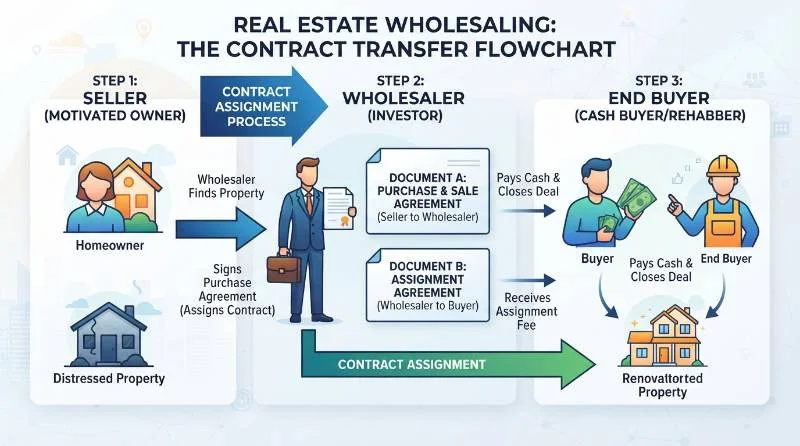
An assignment transfers the assignor’s rights and benefits under a contract to a new party, but the assignor typically remains liable if the new party fails to perform. The original contract stays intact, with an added party now handling performance. Many real estate purchase contracts allow assignment by default unless the contract specifically prohibits it, which is why wholesalers frequently use assignment clauses rather than novation.
Novation, by contrast, extinguishes the original contract and creates a new one. The original party has no remaining liability once the novation is signed. This is a meaningful legal difference, particularly for wholesalers or investors who want a clean exit rather than lingering exposure if their buyer defaults.
Sellers and lenders generally view novation as the safer route for their own protection too, since it forces a documented, mutual release rather than leaving an assignment’s original party technically on the hook.
Common Uses of Novation in Real Estate
1. Wholesaling and Contract Novation
Wholesalers sometimes use novation instead of assignment when a seller’s contract explicitly bars assignment, or when the seller wants full assurance that the original wholesaler has no further involvement. Because novation requires the seller’s active participation and signature, it takes more coordination than a straightforward assignment, but it gives the seller cleaner recourse if the new buyer fails to close.
Novation also helps when a wholesaler’s end buyer wants their own name on record from the start, for financing or title purposes, rather than closing through a double-close or simultaneous assignment structure.
2. Novation in Seller Financing
When a seller carries financing for a buyer and later wants to sell that note to an investor, novation lets the investor step fully into the seller’s position as the note holder. The original seller is released from any remaining obligations tied to the financing arrangement, and the buyer now owes payments to the new note holder under terms that can be renegotiated as part of the novation.
3. Lease Novation
Tenants sometimes need to exit a lease entirely, not just sublease it. A lease novation replaces the outgoing tenant with a new tenant, and the landlord must agree to release the original tenant from future rent obligations. This differs from a standard sublease, where the original tenant usually remains responsible if the subtenant stops paying.
Novation Clause: What to Include in the Agreement
A solid novation agreement should identify all three parties by full legal name, reference the original contract by date and property address, and state clearly that the original party is released from all further obligations. It should also address the status of any deposits or payments already made, specify the effective date of the substitution, and confirm that the new party accepts every term of the original contract unless specific terms are being changed.
Any changes to price, timeline, or financing terms should be spelled out explicitly rather than assumed to carry over. Vague novation agreements are a common source of disputes later.
Advantages and Disadvantages of Novation
Novation gives the exiting party a complete, documented release from liability, which is its biggest advantage over assignment. It also gives the remaining party more control, since they must approve the replacement rather than simply being notified. For lenders and sellers carrying financing, novation offers a cleaner paper trail for accounting and legal purposes.
The tradeoff is that novation takes more time and cooperation than assignment. The remaining party can refuse outright, and there is no way to force a novation without their consent. Because a full new agreement has to be drafted, novation also typically involves more legal review, which can slow down a deal that needs to move quickly.
Legal Requirements for a Valid Novation
For a novation to be enforceable, it needs consent from all three parties, a clear statement that the original contract is discharged, and consideration, meaning something of value exchanged as part of the new agreement. Verbal agreements to novate a real estate contract are risky and difficult to enforce, so the agreement should always be in writing and signed by everyone involved.

Because novation directly affects contract law and property rights, having a real estate attorney review or draft the novation agreement is strongly advisable, particularly when financing, deposits, or existing liens are part of the transaction.
Novation and Mortgages
Novation shows up occasionally with mortgages when a lender agrees to release an original borrower and substitute a new borrower on the same loan terms. This is distinct from a loan assumption, where the new borrower typically still needs separate underwriting approval from the lender. True mortgage novation is uncommon because lenders rarely agree to release a borrower without requalifying the replacement under current underwriting standards.